Graph engineering
Graph engineering move
For the past few years I have been working a lot with graphs. Having some skin in the game around graphs helps you understand the bigger picture when particular trends appear. Right now, the latest trend is what gets called “graph engineering“, a term popularized by Peter Steinberger, the author of OpenClaw.
The latest premise is that we may be transitioning from loops to graphs.
The idea is simple if we look at it from one perspective: through the lens of time, and through how we have become used to working with LLMs.
Moving in a line
In the early stages of LLM development, problem solving was mostly linear.
You moved through time toward a solution like this:
---> LLM ---> Prompt ---> LLM ---> Prompt---> .... And to eternity, or until the problem is solved
This is how the initial versions of what we now call a harness looked.
Initially, it was just a single prompt: you put some text into the LLM, and the LLM returned the most probable continuation, which often led to a correct solution. Early versions of harnesses had sliding windows, so only a few previous messages were kept in context.
After a few interactions, the beginning of the conversation had completely moved out of the context window.
You were the person pushing the LLM toward a solution. The two of you followed a single thread of work together. It was the bare bones era of 2023. The autonomy of work was still mostly in your hands.
The work was not glamorous and automatic. It meant you were making the decisions and doing the quality control yourself. The model was useful, but it was like a very confused intern with great self-esteem.
Moving in a loop
The limitation of the line is that you have to make the line work and push the line further. You need to guide the LLM toward the solution.
In the meantime, LLMs gained access to tools and MCP servers, which gave them hands to operate more autonomously. This meant the LLM was now mostly capable of solving smaller tasks from start to finish.
That also meant you were the bottleneck in accessing their potential output. This is where loops come in.
Obviously, if you are moving in a loop, there is some circular condition that keeps repeating.
There is a start state and an end state, so it is not a perfect circle. It is closer to a state machine that your LLM moves through until it decides it has completed the task and breaks the loop.
So it is a state machine with a fairly rigid structure that predefines the states, something like this:
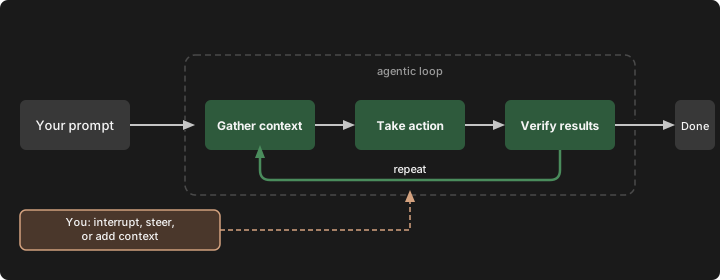
This picture is from the Anthropic Claude agentic loop docs
At this stage, an interesting dynamic appears. The two of you are no longer really collaborating in the same way. The model is trying to find the solution to your problem, and you step in only when needed while it mostly runs on its own inside the loop. You are no longer the bottleneck for every step of the process.
The LLM, or agent if you prefer that term, is actively trying to solve the problem posed by your question. This means the agent has taken some autonomy from you, or more precisely, you have delegated it.
It is autonomous in the way any semi-automatic machine is autonomous: once started, it can run through a sequence without further supervision, but it still depends on someone else to guide it correctly, define success, and clean up when it does something stupid. Think of an automatic lawn mower, except it is not really autonomous, only semi-automatic.
So the nature of work changes. You stop manually advancing every step of the line and start managing boundaries around what it can do. This already shows how powerful loops are.
The typical harness today has a loop. You can also configure different loops and tasks to run on a schedule. For example, every hour it could check which PRs were assigned to you and review them in a semi-supervised way with the tools you gave it.
Moving in a graph
One of the biggest changes happens when you drop fixed structures such as a state machine and move into the domain of graphs. Graphs are strong causality engines because they can represent states that do not yet exist and remain unknown until the future unfolds. Thinking about the lawn mower for a moment, imagine it wandering into your neighbor’s yard and either getting you paid or getting smashed to pieces. You do not know the outcome in advance.
I have written before about why I think the graph model is the most natural fit for these kinds of AI workloads in What is the best data model for AI?.
This matters for the nature of the agentic AI world. If you think about a current LLM as operating token by token, it can take wildly different directions if you change just a few tokens. Each of those directions can be intentional, shaped by you as the composer and coordinator trying to steer the model elsewhere.
Each of those directions is a particular version of the path. At any point, you could have chosen a different route by changing only a few tokens. This yields a graph of traces, changes, and internal thoughts that can be biased toward a particular better solution.
Now imagine an army of LLMs running in loops, solving different problems while cooperating with one another in graph space.
That means you have a subgraph of loops running to solve a particular task, and then those loops create new subgraphs, potentially without end.
Something small like this:
           [Goal]
          /  |   \
         /   |    \
    [Loop A][Loop B][Loop C]
      /   \      \      \
     /     \      \      \
 [Loop A1][Loop A2][Loop B1][Loop C1]
     /   \     ...    ...      ...
    /     \
...      ...
This is where autonomy of work stops being partial to your hands and starts becoming an organizational problem. Once many agents can branch, delegate, and recombine, the human is no longer supervising individual steps. The human is supervising a system of evolving components and failures that happily produce more of themselves. You can model that system only with a graph.
If the graph is specifically organizing context for agents to consume, update, and act on, then it also overlaps with what I called a context graph.
In that world, your job is less about doing the work directly and more about deciding which work deserves autonomy at all. Some tasks benefit from branching, while some of them will fail flat on their face.
All of this happens while you are out drinking a macchiato and wondering whether your future of work is in jeopardy because at that point you have a self-problem solving army of agents working on a graph.
Enjoy Reading This Article?
Here are some more articles you might like to read next: